What is a value chain, actually? Traditionally we might think of them as a supply chain plus the business processes and services. But in today’s world that is no longer a simple linear sequence, but a vast network of people, technology and relationships.
Since the term was coined in the 80s, executives have been optimising their value chains for efficiency. In these volatile times of transforming globalisation, they may instead need to be optimised for adaptability.
A new book co-authored by Paolo Taticchi, Professor of Strategy and Sustainability at UCL School of Management, examines how organisations can redesign their value chains to navigate growing geopolitical uncertainty, technological disruption and climate-related risks.
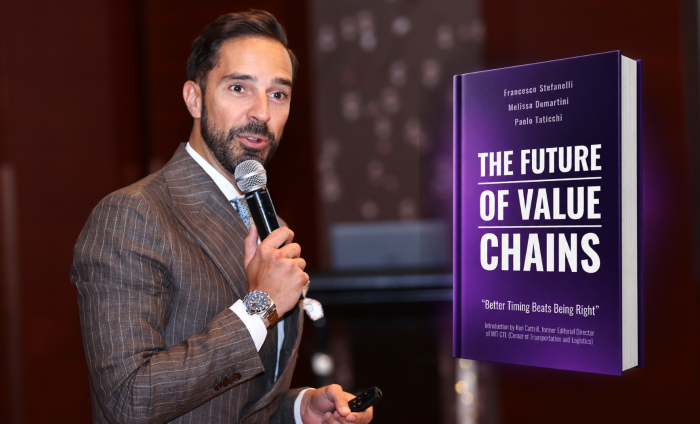
Published this month, The Future of Value Chains: Better Timing Beats Being Right brings together insights from supply chain expert Francesco Stefanelli, Melissa Demartini of EADA Business School and Professor Taticchi to explore how companies are adapting to an increasingly volatile global environment.
Drawing on interviews with senior leaders from organisations including Pirelli, Leonardo, Bottega Veneta, J.P. Morgan, TechMet and The Reshoring Initiative, the book argues that traditional assumptions about efficiency, stability and globalisation no longer hold. Instead, successful organisations are developing value chains that are more adaptable, resilient and responsive to change.
Professor Taticchi said:
“For decades, businesses could plan around the assumption that stability was the norm and disruption was the exception. Today, that reality has been reversed. This book shows that competitive advantage increasingly belongs to organisations that can adapt faster than the world around them changes.
“The future is not about predicting every disruption, but about designing value chains that are resilient, flexible and ready to evolve.”
The authors argue that the world is witnessing not the end of globalisation, but the end of what they describe as “linear globalisation”. Geopolitical tensions, trade disputes, supply chain disruptions and rapid advances in artificial intelligence are reshaping how organisations source materials, manufacture products and deliver value to customers.
The book highlights how value chains have become a boardroom concern, with issues such as access to critical materials, regulatory compliance, climate resilience and the strategic use of AI now central to business decision making.
It also examines the growing importance of human judgement, arguing that organisations must combine data and artificial intelligence with leadership and critical thinking to make effective decisions under uncertainty.
Alongside its analysis of emerging trends, the book offers eight practical rules for operating in a world of permanent volatility. These include designing for adaptability rather than optimisation, building “smart redundancy” into critical operations, integrating circularity into value chain design and treating volatility as a long-term condition rather than a temporary challenge.
The book builds on ideas explored through The Future of Value Chains podcast, co-hosted by Professor Taticchi and Stefanelli. The first season featured 15 interviews with academics, business leaders and practitioners from around the world discussing the future of global business, supply chains and sustainability.
The Future of Value Chains: Better Timing Beats Being Right was published in September 2026 and is available in paperback and digital formats.
Read more https://thefutureofvaluechains.com
