The 2026 theme for South Asian Heritage Month is Unity in Diversity, running from 1st to 31st July 2026. This theme highlights the vast richness of South Asian communities, celebrating shared values and intertwined histories across eight nations while honoring individual cultural identities.
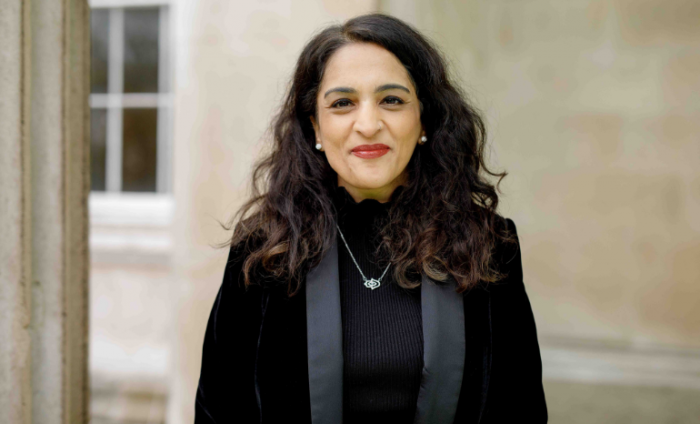
As part of UCL School of Management’s SAHM celebrations, we are spotlighting Professor Harveen Chugh, UCL Flex MBA Programme Director, about identity, belonging and leadership. Reflecting on her career journey, Professor Chugh shares how her understanding of authenticity at work has evolved, why visibility and representation matter, and how students’ responses have reinforced the impact of diverse leadership. From bringing more of her culture into the workplace to encouraging others to claim their space, her reflections offer a personal perspective on the power of belonging and the importance of staying the course.
Can you tell us a bit about your personal and career background?
My parents migrated from India to England and I was born and raised here. While I am British, my heritage is Indian, and throughout my life I have felt connected to both British and Indian cultures, embracing the similarities while also navigating the differences.
My education and career have both been in England. I went through UK school and sixth form, through to university and then progressed further into higher education, which has been my main career focus. I have studied and worked at six universities throughout my career and most recently joined UCL School of Management in 2024 as Professor of Entrepreneurship. A few months after joining, I took on the role of MBA Director.
Can you describe a specific interaction with a student or colleague where you felt your background or visibility made a real difference?
There was one instance a few months ago when an MBA student told me that seeing my picture on the website had influenced their decision to join the programme. More recently, two female MBA students told me how important it was to see me in a leadership role and offered some incredibly encouraging words. For me, those moments were huge. The fact that they took the time to tell me highlighted just how powerful it can be to see people from different backgrounds in leadership roles.
It reinforced my belief that seeing someone who looks like you, or whose experiences resonate with your own, can expand your view of what is possible. These moments reminded me that leadership is not only about what you do, but also about what your presence can mean to others. Their words have stayed with me and have helped sustain me through some of the more challenging moments of leadership.
If there’s someone in your workplace whose leadership, experience or visibility has inspired you, I encourage you to tell them. It takes only a minute, but the impact on their confidence, resilience and sense of purpose may be far greater than you could imagine.
Looking back on your career, what do you know now that would have changed how you approached those early years?
Looking back, one of my biggest regrets is not bringing more of myself into work during the early years of my career. For a long time, I hid much of my identity, whether that was talking about the food I ate at home, celebrating religious festivals, or sharing my love of Indian and Punjabi music. It was easier to talk about the parts that I knew others could relate to.
The Black Lives Matter movement in 2020 was a real turning point for me. It prompted me to reflect on what authenticity and inclusion really mean. I realised that I didn’t need to leave parts of my culture at the door and wondered what would happen if I started sharing more. As my career progressed and I became more senior, I also started to feel a personal responsibility to be more visible and authentic at work.
What pleasantly surprised me was that sharing more of myself didn’t create distance from colleagues; it often created stronger connections and richer conversations. When my sister got married last year, many colleagues were genuinely curious about the celebrations and traditions involved and I enjoyed being able to share that part of my life and culture with them.
What would you say to a South Asian woman starting her career today who feels she has to change herself to fit in?
I would love to say, “Don’t change.” But it’s easier said than done. It’s completely understandable to worry about how your colleagues might respond, whether their perceptions of you might change, or whether you might be judged differently.What if ignorance or bias influenced how others saw you, treated you, or the opportunities that came your way? The hardest part is often the uncertainty; if bias exists beneath the surface, you may suspect it, but you never truly know.
In many cases, it’s not that South Asian women are changing who they are, but that they’re carefully deciding how and when to reveal more of their culture and identity at work.
My advice would be not to feel pressure to share everything at once. As you build relationships and trust, allow colleagues to get to know the different parts of who you are. Over time, I’ve learned that bringing more of myself to work, including aspects of my South Asian heritage, has strengthened rather than weakened my connections with colleagues. Authenticity doesn’t have to be immediate; it can grow over time.
What do you want to see change for South Asian women in academia and business over the next five to ten years?
I would simply like to see more South Asian women in senior positions across academia and business. Representation matters, not only because of what it signals to those coming behind us, but because diverse perspectives strengthen institutions and leadership teams. If I look at the School of Management today, I can only count myself as a South Asian woman at a senior level. I’d love for that to no longer be the case in five years’ time.
I’m encouraged by the growing focus on diversity and inclusion across the School, and I hope that continued efforts to attract, develop and support diverse talent will lead to greater representation at senior levels in the years ahead.
What role do you see yourself playing in driving that change?
Continuing to do what I’m doing. There are times when leadership can be challenging, but I remind myself why staying the course matters. By continuing to lead and be visible, I hope I can show other South Asian women that they can claim their space too. I want to represent a South Asian woman who is strong, resilient and keeps showing up. As a final note, it would have been easy to decline to write this piece. It is often easier to stay in the background. But if visibility matters, then it has to be more than advice we give to others; it is something I have to practise myself. If sharing my experiences helps even one South Asian woman at UCL feel that she belongs, or see new possibilities for herself, then I’m glad I made the time.